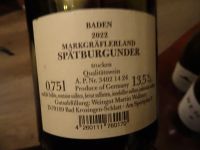
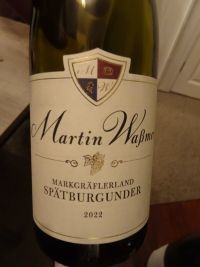
Markgräflerland Spätburgunder
Overview
This 2022 Martin Waßmer Spätburgunder exemplifies the elegant, terroir-driven potential of the Markgräflerland, marrying the warmth of the vintage with the region's inherent freshness. The wine demonstrates sophisticated winemaking that prioritizes transparency and finesse over extraction, resulting in a Pinot Noir of crystalline purity and aromatic complexity. While immediately appealing for its vibrant primary fruit and floral perfume, the underlying mineral structure and refined tannins suggest a capacity for graceful evolution over the next 3-5 years. A compelling expression of Baden's finest red wine tradition, equally suited to contemplative solo drinking or pairing with roasted game birds and mushroom-based cuisine.
Appearance
The crystal-clear brilliance and vibrant colour saturation speak to meticulous vineyard management and gentle handling in the cellar. The slight purple inflection at the rim confirms the wine's primary fruit stage, while the moderate staining suggests healthy phenolic extraction without heaviness. This visual presentation is characteristic of the Markgräflerland's ability to achieve phenolic maturity while retaining luminous clarity.
Nose
The bouquet rises with immediate aromatic lift, presenting a crystalline expression of red forest fruits that seems to shimmer above the glass. There is an intoxicating interplay between crushed wild strawberries and just-ripe raspberries, underscored by a distinct stony minerality that evokes the limestone soils of the Markgräflerland. As the wine opens, subtle sweet spice emerges—like cinnamon stick and vanilla pod—woven delicately into a backdrop of rose petal and crushed violets. The overall impression is one of transparency and precision, where each aromatic layer maintains distinct boundaries yet harmonizes into an elegant, Burgundian-inspired whole.
Intensity: Pronounced | Condition: Clean, expressive, vibrant
Primary Aromas
Secondary Aromas
Tertiary Aromas
Palate
Flavours: Wild strawberry, sour cherry, raspberry coulis, pomegranate, rose hip, cinnamon, wet limestone, graphite, subtle forest floor, blood orange zest
Finish: Medium-plus to long, with a persistent echo of red berry fruit and crushed stone minerality; the finish resolves with remarkable clarity, leaving impressions of cranberry and saline chalk
Quality: Very Good to Outstanding
Structure
Terroir
The Markgräflerland constitutes the southernmost winegrowing district of Baden, situated in the triangular borderland between Germany, France, and Switzerland. This region benefits uniquely from the 'Burgundian Gate' (Burgundische Pforte), a geographical corridor that channels warm Mediterranean air masses northward from the Rhône valley, creating Germany's warmest and sunniest winegrowing climate with over 1,700 annual sunshine hours. Vineyards are typically positioned on gentle south-facing slopes and terraces between 200-400 meters elevation, nestled between the protective Black Forest and the Rhine Valley. The combination of intense daytime heat and cooling nighttime air drainage from the surrounding forests creates an optimal mesoclimate for Spätburgunder, allowing full phenolic ripeness while preserving acidity. The soils are characterized by deep Quaternary loess deposits over ancient limestone bedrock, providing both water retention capacity and mineral complexity.
Geology
The substantial loess topsoil (often several meters deep) provides excellent water retention and fertility, ensuring vine health during the region's increasingly dry summers, while the underlying limestone and marl bedrock offers superb drainage and contributes distinct mineral notes, chalky texture, and structural tension to the wine. This geological combination creates moderate hydric stress that encourages deep root penetration and concentrated fruit with fine, silky tannins rather than aggressive extraction.
Climate
Diurnal Range: Significant temperature variation of 10-15°C between warm days and cool nights, particularly pronounced during the ripening and harvest periods
Vinification
Traditional Burgundian-influenced vinification with precision-oriented modern techniques
Hand-harvested grapes undergo careful destemming and cold maceration for 5-7 days to gently extract color and primary fruit aromatics; fermentation proceeds in stainless steel or open wooden vats with regular manual punch-downs (pigeage) and indigenous yeasts, followed by full malolactic conversion; the wine ages for 12-18 months in French oak barriques (approximately 20-30% new wood for this Qualitätswein tier) with minimal fining and light filtration before bottling
Minimal interventionist approach emphasizing terroir transparency, with gentle extraction methods that prioritize elegance and site-specific mineral character over power or concentration; the winemaking seeks to translate the unique Mediterranean-influenced Markgräflerland terroir into glass
Winery History
Founded: 1994
Located in Schlatt am Randen at the southern edge of the Black Forest, Weingut Martin Waßmer was established in its current form when Martin Waßmer took over his family's estate and restructured it toward quality-focused production. The winery has since become a benchmark producer for the Markgräflerland region, gaining particular recognition for elevating both Spätburgunder and the indigenous Gutedel (Chasselas) varieties to international acclaim through meticulous vineyard work and terroir-driven winemaking.
Winemaker: Martin Waßmer
Sustainable viticulture with obsessive handwork in the vineyard, strictly limited yields, and gentle cellar practices that prioritize the expression of terroir over technical manipulation; the winery adheres to the philosophy that 'great wine is created in the vineyard' rather than through cellar intervention
Food Pairings
Vegetarian & Vegan
- Wild mushroom risotto with black truffle oil and toasted pine nuts
- Roasted beetroot tart on walnut pastry with vegan cashew cream and fresh thyme
- Grilled king oyster mushrooms with smoked paprika over warm lentil du Puy salad
- Caramelized celeriac steaks with herb butter and pomegranate molasses glaze
- Aubergine involtini stuffed with raisins, capers, and pine nuts in tomato sugo
- Hand-cut tajarin pasta with garlic, olive oil, and shaved fresh black truffle
- Charred cauliflower steak with romesco sauce and crushed toasted hazelnuts
- Wild rice stuffed acorn squash with dried cranberries, pecans, and sage
Classic Pairings
- Pan-seared duck breast with Baden cherry reduction and red cabbage
- Coq au Riesling with wild mushrooms and pearl onions
- Roast pork tenderloin with grain mustard sauce and buttered spätzle
- Grilled wild salmon with beetroot carpaccio and horseradish cream
- Roast guinea fowl with chestnuts, pancetta, and root vegetable purée
- Beef bourguignon with pearl onions and button mushrooms
- Smoked trout with crispy potato rösti and crème fraîche with dill
- Black Forest ham and aged Comté cheese board with seeded bread
Serving Suggestions
Comments (3)
Sign in to leave a comment.